
The Self-Devouring Argument from Evil
The atheist's sharpest weapon turns in his hand

I put a question to my kids over dinner last night. One of them looked up from their plate and asked me how God could be good if He made a world where so much evil and suffering were guaranteed to happen. Just like that. There was no preamble or lead in. The kind of question that lands in the middle of a family meal and silences the table.
I have four kids. Two teenagers, two on the cusp. All of them deep thinkers. All of them sharp enough to push back or detect a side-swipe of an anserr. I knew I could not palm this one off with a Sunday school answer. They would have devoured me.
So instead of answering directly, I asked them a question of my own. What kind of world did they think would better demonstrate the goodness of God? And to make it concrete, I gave them a scenario.
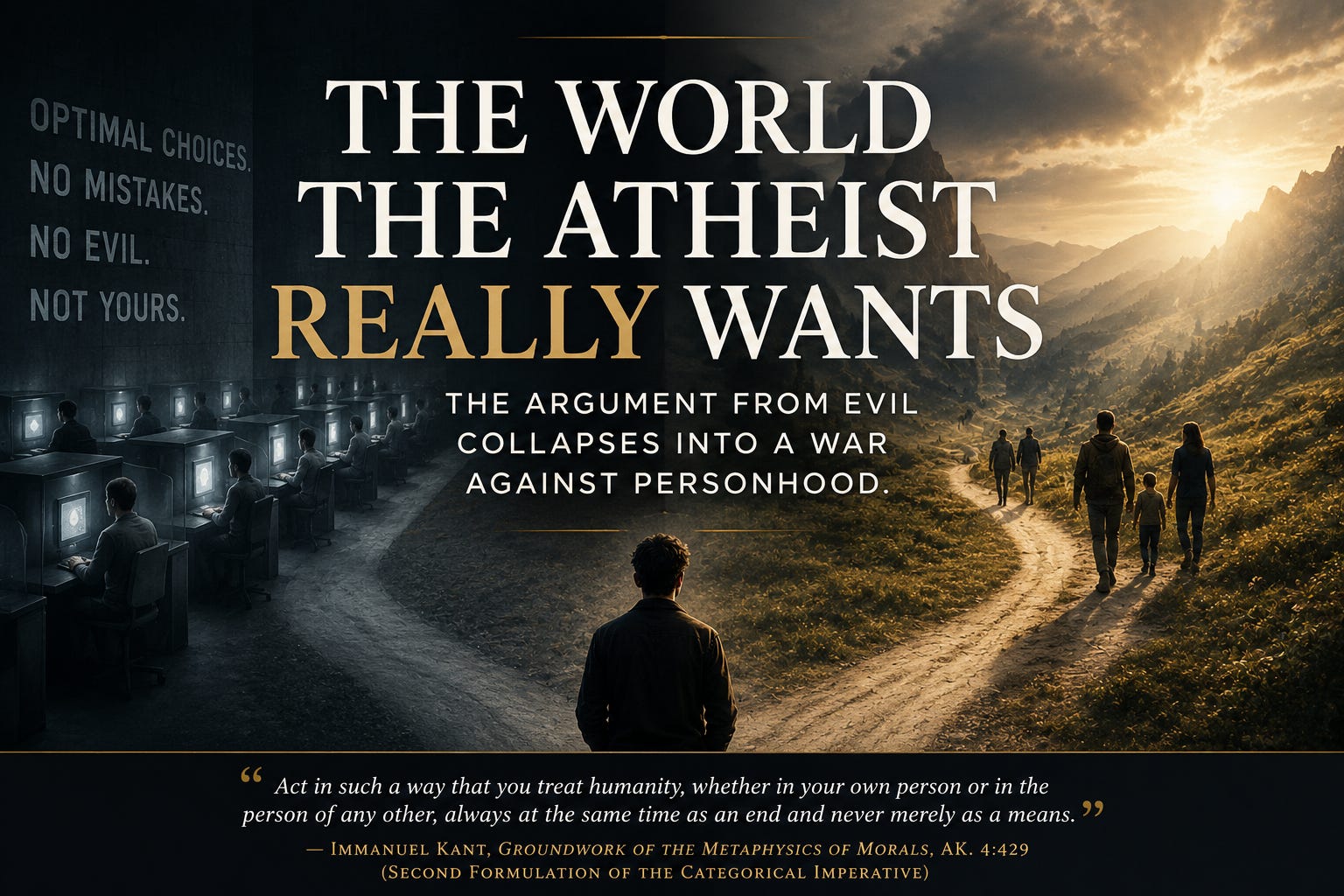
“Imagine you could upload your entire consciousness and decision-making to an AI platform. It would always make the optimal choice in every situation. Every relationship, every career move, every moral dilemma, handled perfectly. You would never make a bad decision again. You would never hurt anyone you love through your own poor judgement. The alternative is to keep your own agency, knowing that on balance you will make worse decisions, and that some of those decisions will cause real harm to yourself and to the people closest to you.”
Every one of them chose to keep their own agency, without hesitation.
When I pressed them on why, they all circled the same intuition, expressed differently but landing in the same place: the AI scenario felt like a true loss of self. Not just inconvenience. Not just a preference for independence. Something deeper. They said it would feel like not being a person anymore. That even a perfect life, if it was not theirs, was not a life at all.
Then I pressed harder.
“You understand what you’re choosing. You’re saying you would rather make decisions that will sometimes cause genuine harm, even to people you love, than have those harms prevented by something else making the decisions for you.”
Not one of them flinched. Every one of them held their answer.
I have been watching atheists argue against the existence of God for decades. The argument from evil is their sharpest weapon, and they know how to wield it. God is not merely negligent, they press, but He is culpable. He created beings capable of horrific evil, placed them in a world where that evil was certain to flourish, and then held them accountable for doing what He made possible. A good God would never have done this. Therefore either God is not good, relatively powerless, or He simply doesn't exist.
The rhetoric is highlyeffective. The emotion behind it is palpable. And I have watched more than one Christian apologist flounder under the weight of it.
But my kids, without knowing it, dismantled the entire argument over mashed potatoes.
What the Atheist is Actually Asking For
The argument from evil only works if there is a better alternative. The atheist must be able to point to a world that a good God should have made instead of this one. And once you ask what that world looks like, the argument dissolves entirely.
Because the only way to guarantee a world without moral evil is to remove the creature’s own willing from the equation. Not merely to limit options. Not merely to educate or guide. To override. To ensure that every action proceeds not from the creature’s own nature but from an external source that has determined the outcome in advance. Not the governance of a wise Creator working through the creature’s own nature. Something far worse. The replacement of the creature’s nature altogether.
My kids recognised that world immediately. They called it the loss of personhood. They were right.
The Horror is Not Abstract
We do not need to speculate about what it means to have your capacity for self-directed action stripped away. We have seen it.
Consider a person in a permanent vegetative state. Biologically alive. Neural activity persists at some level. But the person you knew is gone. The capacity to act from their own nature, to respond, to choose, to initiate as a subject in the world, all of it has collapsed. What remains is a body sustained by machinery and the grief of those who remember who once inhabited it.
Would you want to live like that?
Overwhelmingly, humans judge this the same way. We would rather die than persist in that condition. That is not just a fringe opinion. It is so near-universal that we build legal frameworks around it. We write advance directives. We beg our families not to let us linger there. We call it a fate worse than death, and we genuinely mean it.
This is not mere preference. It is a moral intuition so deep it functions almost as a verdict: a conscious existence in which your actions are no longer your own is not a life. It is a prison sentence served inside your own skull.
Immanuel Kant, for all his efforts to ground morality in reason alone, was at least right about this: to remove a person’s autonomy is among the greatest injustices you can commit against them.
The Critic’s Escape Route is Closed
A critic might object.
A world without evil need not look like a vegetative state. You could have conscious beings who perceive, interact, even converse, but whose choices are overridden at the point of harm. That is not the same thing.
But consider what that produces. If the being perceives, but its responses are corrected before they can cause damage. If it deliberates, but the conclusions are pre-empted whenever they tend toward harm. If it wills, but the will is vetoed at the threshold of any action we disapprove of. Then the being is not a genuine subject. It is a performer in a theatre where the script has already been written and the director intervenes whenever an actor departs from the approved lines.
The inner life of such a being, if it has one, is the experience of reaching for something and finding your hand has already been moved. That is not a richer version of existence than the vegetative state. It is a more elaborate version of the same deprivation, dressed in higher cognitive function.
My kids saw this without needing the metaphysics explained. The AI would, unquestionably, make better decisions. They knew that to be certain. They chose worse decisions that were theirs over perfect decisions that were not theirs. The optimised life, the life without error and without harm, was not a life they wanted, because it was not a life they were living. Something else was living it for them, wearing their face.
The Volume Problem Collapses
There is a subtler version of the objection that concedes agency but protests the scale. “Fine, grant creatures the freedom to act from within. But why this much evil? Why the Holocaust? Why child trafficking? Could God not have dialled it back?”
The objection sounds reasonable. After all, who doesn’t feel a fierce gut repulsion at those evils? But examine what “dialling it back” would actually require.
If creatures are genuinely acting from their own natures, and those natures are finite, embodied, epistemically limited, driven by appetite and fear, then the range of outcomes those natures can produce is not a separate variable God adjusts independently. The same human nature that produces sacrificial love also produces calculated cruelty. The same father who would die for his child is the same kind of creature who, under different pressures and different failures, is capable of monstrous harm. The magnitude of good and the magnitude of evil are two expressions of the same endowment.
To systematically prevent harmful outcomes is to override the creature at every point where its nature tends toward harm. But that is the AI scenario again. The creature wills, and an external agent intervenes to correct the outcome. My kids already told you what that feels like. It feels like not being a person.
The only way to eliminate the evil without overriding the creature is to reduce the capacity of the creature itself. Make it less capable, less complex, less able to act in the world. But that is not a better version of human existence. It is a diminished one. And the atheist, who values human dignity and human capacity above almost everything, is now asking God to have created less of both.
The Atheist Borrows What They Cannot Own
Here is where the argument turns fatal for the sceptic, and not in the direction they expect.
The atheist lives in the same world of staggering harm. They see it, name it, and are rightly horrified by it. But their framework provides no accounting for the horror. Under strict materialism, suffering is simply what happens when matter arranges itself into organisms complex enough to feel pain and inflict it. It is not unjust. It is not a violation. It simply is.
The God hypothesis does not introduce suffering into the world. Suffering is already here, on every account. But the atheist cannot simply assume the moral architecture their objection requires. To call suffering wrong is to invoke a framework in which “ought” and “ought not” have real purchase, and that framework does not come free of charge with materialism.
The atheist does not merely borrow the word. They borrow the entire architecture that gives the word its force. Injustice, violation, the conviction that things have gone terribly wrong, these are categories that require a morally ordered universe. And that universe does not exist within the worldview the atheist is defending. They are setting fire to the only house that contains the language they are shouting in.
The Argument That Defeats Itself
Follow it right to the end.
The atheist says: “God should not have made a world where evil flourishes.”
What they mean is: “God should have overridden the creature’s nature to prevent harmful outcomes.”
What that produces is: a world in which no creature’s actions are genuinely its own.
What my kids called that is: the loss of personhood.
The atheist’s recommended alternative is a greater horror than the world they are protesting.
But there is a deeper self-refutation still. The objection to evil is itself an act of genuine agency. The atheist perceives injustice, forms a judgement, constructs an argument, and levels a charge against God. Every one of those acts flows from the atheist’s own nature, their own reasoning, their own moral sensibility. And every one of them presupposes the very condition the atheist argues God should have prevented.
The argument from evil can only be made by a creature acting from within. And it can only be made against the existence of that very condition.
The atheist uses their own willing to argue that their own willing should never have been granted. The critique does not merely fail. It devours itself.
What God Actually Did
Scripture does not present God as an anxious designer who overrides His creatures to prevent undesirable outcomes. It presents Him as a Creator who made image-bearing beings and immediately gave them their own work to do.
Then God said, “Let Us make man in Our image, according to Our likeness; let them have dominion over the fish of the sea, over the birds of the air, and over the cattle, over all the earth and over every creeping thing that creeps on the earth.”
Out of the ground the LORD God formed every beast of the field and every bird of the air, and brought them to Adam to see what he would call them. And whatever Adam called each living creature, that was its name.
Dominion. Naming. Cultivating. Shaping. From the first moment of human existence, the image of God is not passive awareness but the creature acting from within. God did not place Adam in the garden to watch. He placed him there to work it and keep it. He brought the animals to Adam not to be labelled by divine decree but to receive whatever name Adam, from his own nature, chose to give. The text is extraordinary in its implications: God made a creature and then gave that creature genuine authority to act.
This is not a reluctant permission. It is the point of the whole project. The image of God, expressed in human beings, is the image of a God who acts, who speaks, who initiates, who creates. Strip the creature of that capacity and you have not protected the image. You have defaced it.
The Only Honest Conclusion
God did not commit an injustice by creating beings whose natures would lead to a world saturated with evil. The alternative was to override those natures, to produce a world of sentient beings whose actions were never genuinely their own, beings sealed inside a life they could feel but never author.
My kids understood this even as I completed asking my question. They chose the harder world. They chose the world with consequences, with failure, with harm they themselves would inevitably cause. And they chose it because the alternative was not a better life. It was no life at all.
The world we inhabit is not evidence against the goodness of God. It is evidence of how seriously God took the project of making persons rather than ornaments. The evil is real. The suffering is staggering. And neither fact proves what the atheist thinks it proves, because the alternative is not a better world. It is not even a recognisably human one.
Every person who has ever looked at the state of the world and cried out, “This is not how it should be,” has, in that very act, vindicated the God who gave them the capacity to say it from their own nature, their own judgement, their own voice.
The atheist borrows the moral vocabulary of a world that only makes sense if God exists, and then uses it to argue that He does not. The argument is not merely wrong. It is self-refuting, and everyone who raises it proves it so by the very act of raising it.
“Act in such a way that you treat humanity, whether in your own person or in the person of any other, always at the same time as an end and never merely as a means”, Kant, Groundwork of the Metaphysics of Morals, Ak. 4:429 (Second Formulation of the Categorical Imperative).
Excellent, Craig. But that's just moral evil. Do you have a related article dealing with //natural// "evil"?
I think this is well argued, but incomplete in a couple of specific ways. To me an obvious question about the restraint God exercises in stopping evil is, "Well, people do intervene to stop evil - we have laws, police, even wars that we consider justified. Why can't he do something about evil and harm if we think people should be allowed to?"
There are two answers that I think are necessary. First, God cannot intervene that way without changing something important about the nature of the mortal experience. After all, fixing cancer would not destroy our agency the way that stopping a thief or a killer would. Giving us a revelation saying, "By the way, you should know about the germ theory" would empower our agency, not threaten it, right? So it must be important that we be given a world where we are on our own - perhaps because, like Ender Wiggin, it is important that we be able to demonstrate what we choose to do when we really are alone. Faith would not be the same with those interventions, and perhaps that's important enough for Him to hold back.
But this also leads to the other important answer to the question of "why doesn't God do something." The answer is that he has - he sent his Son, not only to recover our bodies from death and our souls from damnation, but to fix all of the injustices. If we believe that he can heal a lost soul and a murdered body, he can heal those we hurt. He can fix a genocide that has already happened. *That* is what an infinite atonement from a merciful God implies. That this life is a small part of existence, and that God can heal what was destroyed here and make it right there.